Our Approach to Oracy
Our Approach to Oracy at William Byrd EYFS
At William Byrd Primary School, we believe that every child deserves to have their voice heard. Developing strong communication and language skills is at the heart of our Early Years provision, helping children become confident speakers, thoughtful listeners and enthusiastic learners.
We have worked closely with Torriano Primary School to develop and strengthen our approach to oracy at William Byrd. This collaboration has helped us reflect on our practice and introduce strategies that encourage purposeful talk, active listening and rich conversations throughout the school day.
Across Nursery and Reception, we are embedding these approaches into everyday learning, ensuring that children have meaningful opportunities to express their ideas, develop vocabulary, listen to others and engage in conversations.
Creating a Culture of Talk
We recognise that oracy is not something taught only during a particular lesson. It is woven throughout our daily routines, play experiences and learning opportunities.
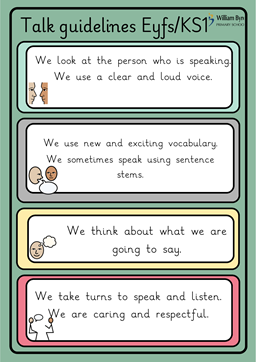
Our classrooms use visual Talk Guidelines and oracy prompts to help children understand important communication skills, such as listening to others, taking turns, using new vocabulary and thinking about what they want to say.
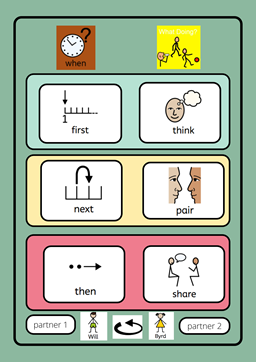
We also encourage partner talk, giving children opportunities to rehearse their ideas with a friend before sharing them with a wider group. This helps build confidence, particularly for children who may be less comfortable speaking in front of others.
Word of the Day – Bringing Vocabulary to Life
One of the ways we develop children's vocabulary is through our Word of the Day approach.
Words are carefully selected to make learning meaningful. They may relate to a topic or concept children are exploring, vocabulary from different curriculum areas, or misconceptions that practitioners notice during conversations, learning activities or play.
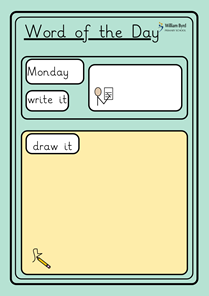
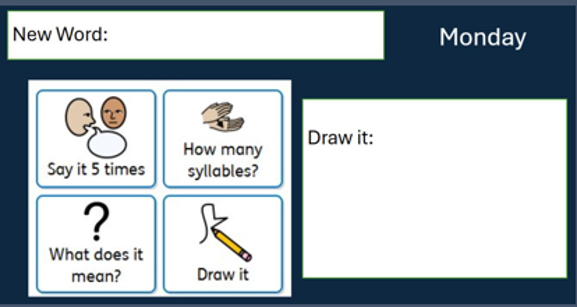
Rather than teaching new words in isolation, we embed them within children's everyday learning. When introducing a new word, children are encouraged to say it aloud, clap or count its syllables, discuss its meaning with a partner and think of an action to represent it. Practitioners model responses and share ideas they have heard during partner discussions, helping children feel confident to contribute without the pressure of providing an immediate answer.
Our Word of the Day posters also provide space for adults to draw pictures representing new vocabulary. These illustrations give children a visual reminder of the word, supporting their understanding and helping them make connections between language, images and real-life experiences.
Throughout the week, children revisit the vocabulary they have explored, strengthening their understanding through repetition, discussion and practical experiences.
Talking Points – Encouraging Children to Think, Discuss and Share
Another important part of our approach to Oracy is the introduction of Talking Points.
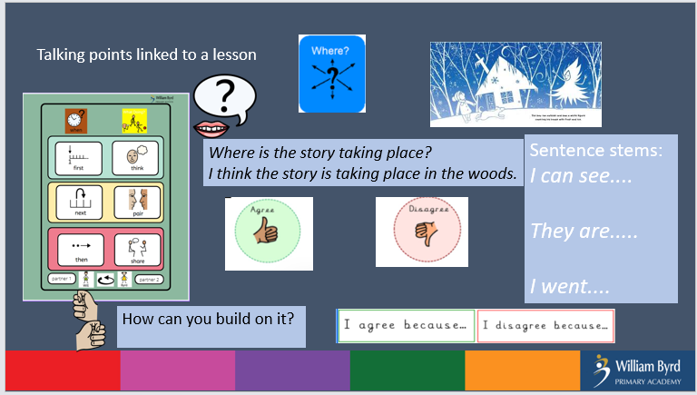
These are carefully selected questions, pictures or statements linked to children's learning, designed to encourage discussion, develop reasoning and help children express their ideas.
For example, while exploring a story, children might discuss where it takes place and explain what they notice in the illustrations. When learning about the seasons, they might look at a picture and discuss the clues that help them identify a particular season.
We introduce sentence stems such as "I think... because...", "I can see..." and "I agree because..." to help children structure their responses and gradually develop more detailed explanations.
Talking Points also encourage children to listen to different ideas, agree or disagree respectfully and build on what others have said.
Building Confident Communicators
Our work with Torriano Primary School, alongside evidence-informed approaches such as ShREC, has helped us develop a consistent and purposeful approach to communication and language across our Early Years.
Through rich vocabulary experiences, visual prompts, partner talk, Talking Points and high-quality interactions, we are creating an environment where children feel confident to share their thoughts, ask questions, listen to others and develop their own ideas.
Our ambition is simple: to give every child the confidence, language and opportunities to make their voice heard.
At William Byrd, we believe that every conversation is an opportunity to learn, and every child's voice matters.